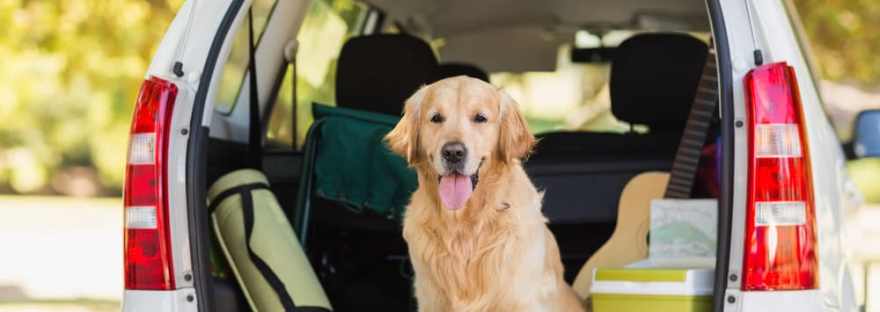
The holidays are fast approaching, and you plan to take your whole little tribe out on the road. Your pet will be there and will travel with you! But how do you transport a dog or a cat in the car? What are the right actions to adopt for a safe journey? Carrefour Assurance advises you on a hassle-free trip with your furball.
The right way to make your pet travel safely
Traveling with your companion while ensuring their safety and that of all passengers on board is possible! The first safety rule: never to let it circulate in the passenger compartment. Depending on the size of your animal, you have different possibilities.
With a medium or large dog
To travel serenely with your medium or large dog, do not install it in the passenger seat next to you: your concentration will be compromised, and safety on board will not be guaranteed.
The safest way to make it travel is with a good quality transport box placed in the trunk without a parcel shelf. Well wedged on one side, it will resist braking or impact.
You can optionally leave your dog free in the boot, provided you install a strong enough barrier and properly secured it to separate it from the passengers. Please be cautious, but do NOT ever lock your dog into the safe. This could potentially happen if you do that and it is closed: There is a risk of suffocation and or a close encounter of the claustrophobic kind.
With a small dog or a cat
To travel serenely with your cat or small dog in the car, a crate or the transport basket is required. There are different models on the market, adapted to the weight and size of your animal. Choose a strong cage that is spacious enough so that he can feel comfortable without risking escaping.
Do not place your animal in the trunk but rather on the back seat, with the box’s opening facing the seat. Ensure the seat belt is securely fastened around the body to prevent it from turning over or being thrown into the passenger compartment if the vehicle is involved in an accident.
What are the risks of traveling by car with your pet?
- Why is it so important to take such security measures? Quite simply because letting your pet move freely in the car involves many risks.
- It is a distraction factor: the animals transported are the 3rd cause of distraction of drivers behind cell phone use and children.
- In the event of an impact, the animal can be thrown and make the accident much more serious for the driver and passengers.
- It can get stuck between the pedals or under the seat, solicit caresses or attention (16% of French people take the animal on their knees while driving), and thus put their lives and those of others in danger.
- Beyond the danger, it is an offense to let your animal move freely in the car. If your animal is not tied in a control event, you risk a 4th class fine, set at 135 $.
Did you know?
1 in 3 people regularly transport their pet in a car, but only 1 in 5 drivers systematically attach them to the vehicle. The figures are clear: it is mainly out of ignorance that drivers commit an offense by not attaching their companion to the car’s back.
Tips for traveling well with your pet
When your pet is not used to traveling in cars or making long journeys, he may show signs of anxiety and restlessness. However, a dog or a cat agitated in the car represents an additional danger: its reactions can be unpredictable, untimely barking or meowing can distract you, or your animal can be aggressive in the event of a panic attack. To ensure everyone’s safety, here are some tips to help your little companion experience this long journey.
A few days before departure
- Some animals are reluctant to travel by car because they associate it with a negative event (visit the veterinarian, for example). Learn about your pet’s instinctive reactions beforehand to take into consideration his/her needs and desires. The use of time on the road can be a useful tool for easing into the situation.
- If you have planned to have your animal travel in a transport crate, the mistake is to present it to him at the last moment. A few days before departure, leave the cash register within reach, open, and with objects that carry its odor (toy, blanket, etc.). The crate should look like a cozy little nest. Your cat or dog might even sleep there on its own! By taking it easy and venturing out more, he will be more comfortable with it and not start this as a stress source when driving his car.
- If you know from experience that your pet is anxious or sick in the car, ask your veterinarian or your pharmacist for advice: he will prescribe an appropriate treatment? # or – -> Take the distressing things (anxious or – sick) and state them in the second clause on a higher word count.
Just before leaving
- Three hours before departure, do not give your pet anything to eat to avoid vomiting during the journey.
- For dogs, a long walk before setting out is ideal for working out and reducing stress.
- If your veterinarian has prescribed a special treatment (anti-stress or anti-vomiting), especially do not forget to administer it!
During the trip
- Keep a close eye on your dog. Take breaks every two hours, stretch your dog’s paws, and let him drink a little water. Since your cat is ill, you’ll have to change the mattress sheet in its crate and provide him or her with a drink.
- Never let your dog stick his head through the window: this is at risk for his eyes and ears.
- If you take breaks during the trip, keep your dog firmly on a leash as soon as you get out of the vehicle. Above all, don’t let your cat leave his transport crate.
- Upon arrival, reward your dog for his patience by offering him a long walk. A big caressing session is also essential for dogs and cats alike!
Suppose you plan a trip in Karachi and looking for a comfortable rental car, contact Carlay Car Rental, which provides rent a car in Karachi to make your trip amazing.

 Blog Vision